Charting
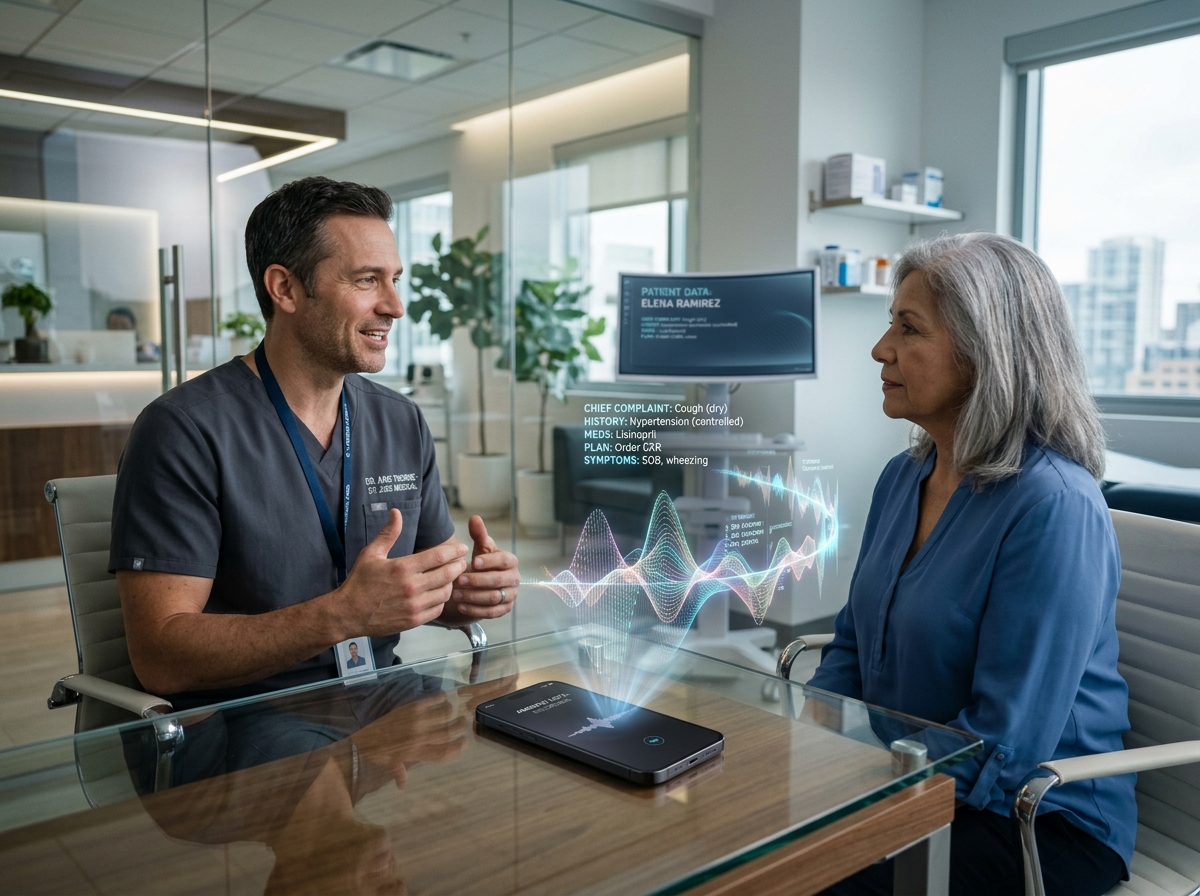
Our ambient AI listens to the full patient encounter and converts natural conversation into a complete, structured clinical note — automatically. The physician reviews and signs off. That is all.
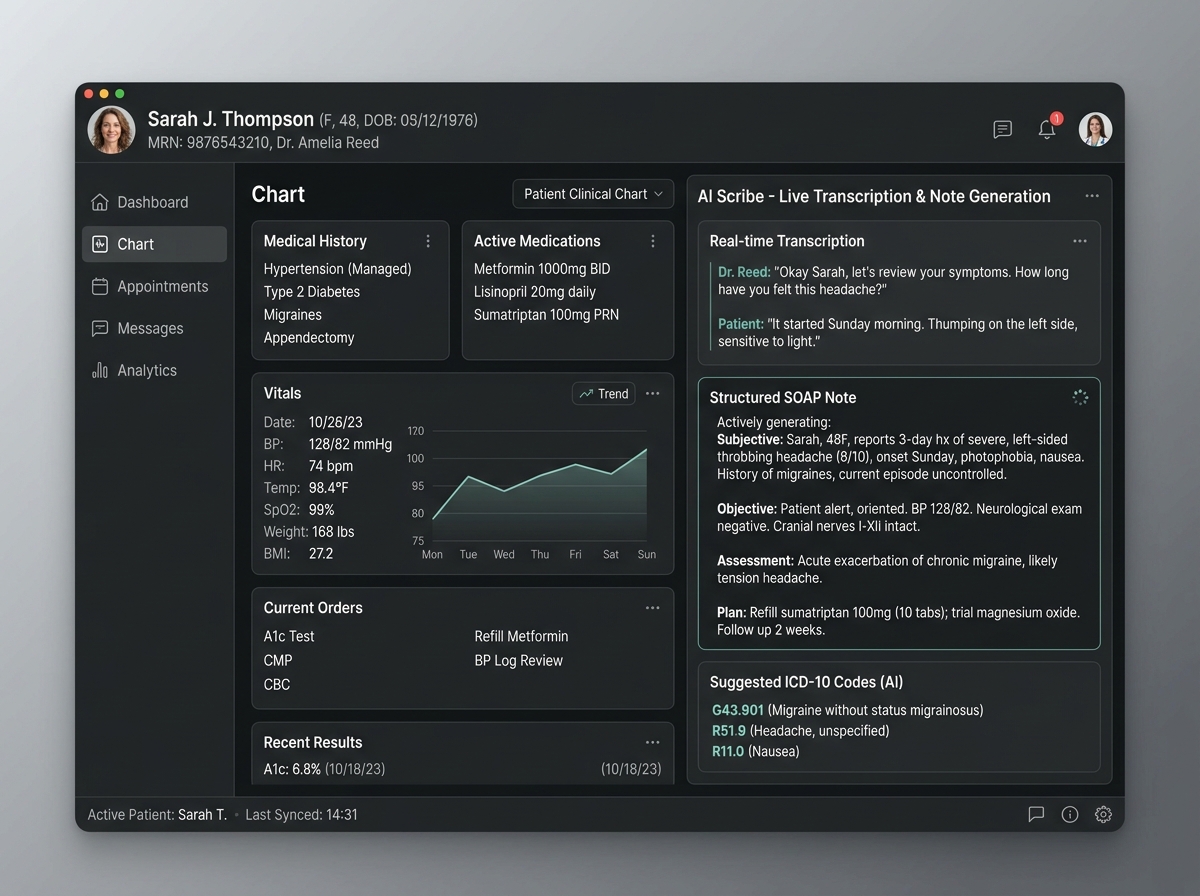
Our AI Medical Scribe listens to patient-provider conversations in real time and delivers structured clinical notes, automated coding, and orders all in under 15 seconds. No copy-paste. No after-hours charting. No wearables or additional hardware required.
[Subjective] Patient reports 3-day non-productive cough, fatigue.
[Assessment] Acute viral upper respiratory tract infection. ICD-10 J06.9
Physicians today spend nearly 2 hours on documentation for every hour of direct patient care. Our AI Medical Scribe changes that equation entirely — combining ambient listening, automated clinical documentation, intelligent coding, and workflow management into a single, deeply integrated solution.
Our ambient AI listens to the full patient encounter and converts natural conversation into a complete, structured clinical note — automatically. The physician reviews and signs off. That is all.
The system suggests accurate ICD-10 and CPT codes in real time as the encounter unfolds — reducing claim rejections, accelerating reimbursements, and removing the guesswork from revenue cycle management.
Diagnoses, prescriptions, lab tests, referrals, and follow-up appointments are generated automatically from the documented encounter — surfacing only the cases that need clinical review.
Refill requests, follow-up bookings, and appointment management are handled directly within the workflow. Patients confirm their details; the AI handles the rest.
Our AI Medical Scribe works seamlessly across in-person visits, follow-up appointments, and virtual consultations — delivering consistent, accurate documentation regardless of how care is delivered.
Pre-configured clinical content and specialty-adapted templates ensure the system works the way your team already works — from primary care and cardiology to psychiatry, orthopaedics, and beyond.
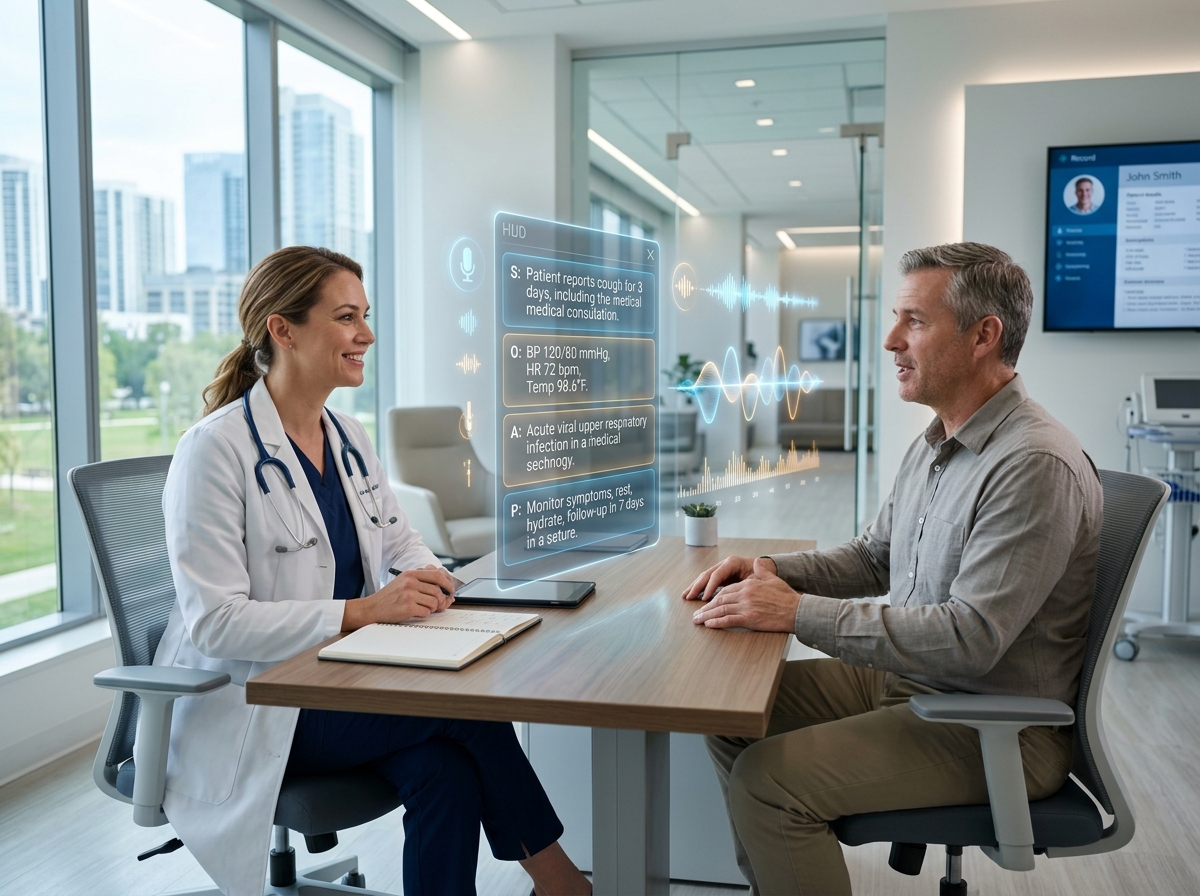
The best technology disappears into the workflow. Our ambient AI scribe is designed to be invisible — running quietly in the background so physicians can stay fully present with the patient, not distracted by documentation.
The ambient AI scribe activates at the start of the encounter and passively listens to the full patient-provider conversation. No scripting, no prompts, no structured questions required. The physician simply cares for the patient as they normally would.
As the conversation unfolds, the system converts speech into a structured clinical transcription in real time, extracting diagnoses, symptoms, history, review of systems, physical exam findings, and recommended orders without manual physician input.
When the encounter ends, the physician receives a complete, structured note ready for review. Any edits are made inline. The note is signed in seconds, not at 10 PM. The system learns continuously from every edit to match individual physician preferences.
Clinical documentation is only valuable when it is accurate, complete, and structured in a way that reflects how your specialty actually works. Our AI SOAP Notes engine is trained on real clinical language — by practising physicians — and adapted to the specific documentation requirements of over 30 medical and surgical specialties.
SOAP stands for Subjective, Objective, Assessment, and Plan — the universal framework for clinical documentation. Our system auto-populates each section from natural conversation into complete, specialty-appropriate notes.
Trained on real clinical language by practising physicians across 30+ specialties, ensuring notes are clinically meaningful, defensible, and compliant with billing standards.
Learns from every physician edit and approval — gradually mirroring personal phrasing, structure preferences, and clinical emphasis over time.
Accurately differentiates multi-party speakers (caregivers, interpreters), processes all accents and dialects, and integrates historical patient data into new notes.
62yo male reports intermittent exertional chest tightness for 2 weeks, radiating to left shoulder. Denies syncope.
BP 138/86 mmHg, HR 74 bpm regular. S1/S2 normal, no murmurs. EKG: Normal sinus rhythm, non-specific T-wave flattening.
Atypical angina pectoris ICD-10 I20.9. Essential hypertension ICD-10 I10.
Order outpatient myocardial perfusion SPECT CPT 78452. Initiate Rosuvastatin 20mg PO daily. Follow up in 2 weeks.
45yo female with right knee pain following tennis injury 3 days ago. Audible pop heard during pivoting motion.
Moderate joint effusion right knee. Lachman test positive with soft endpoint. McMurray test positive medially.
Tear of anterior cruciate ligament, right knee ICD-10 S83.511A.
Order MRI right knee without contrast CPT 73721. Dispense hinged knee brace. PT referral.
4yo male brought by mother with 2-day fever to 101.8°F and right ear tugging. Appetite slightly decreased.
Right tympanic membrane erythematous, bulging with reduced mobility. Left TM clear. Oropharynx normal.
Acute suppurative otitis media, right ear ICD-10 H66.001.
Amoxicillin 90 mg/kg/day divided BID x 10 days. Acetaminophen PRN. Re-evaluate in 14 days if not resolved.
54yo male presents for routine Type 2 Diabetes follow-up. Checking home glucose (average 135 mg/dL).
BMI 28.4 kg/m². Monofilament foot exam: 10/10 sensation bilaterally. Point-of-care HbA1c: 6.8%.
Type 2 diabetes mellitus without complications, well-controlled ICD-10 E11.9.
Continue Metformin 1000mg BID. Order lipid panel & urine microalbumin. Annual diabetic eye exam scheduled.
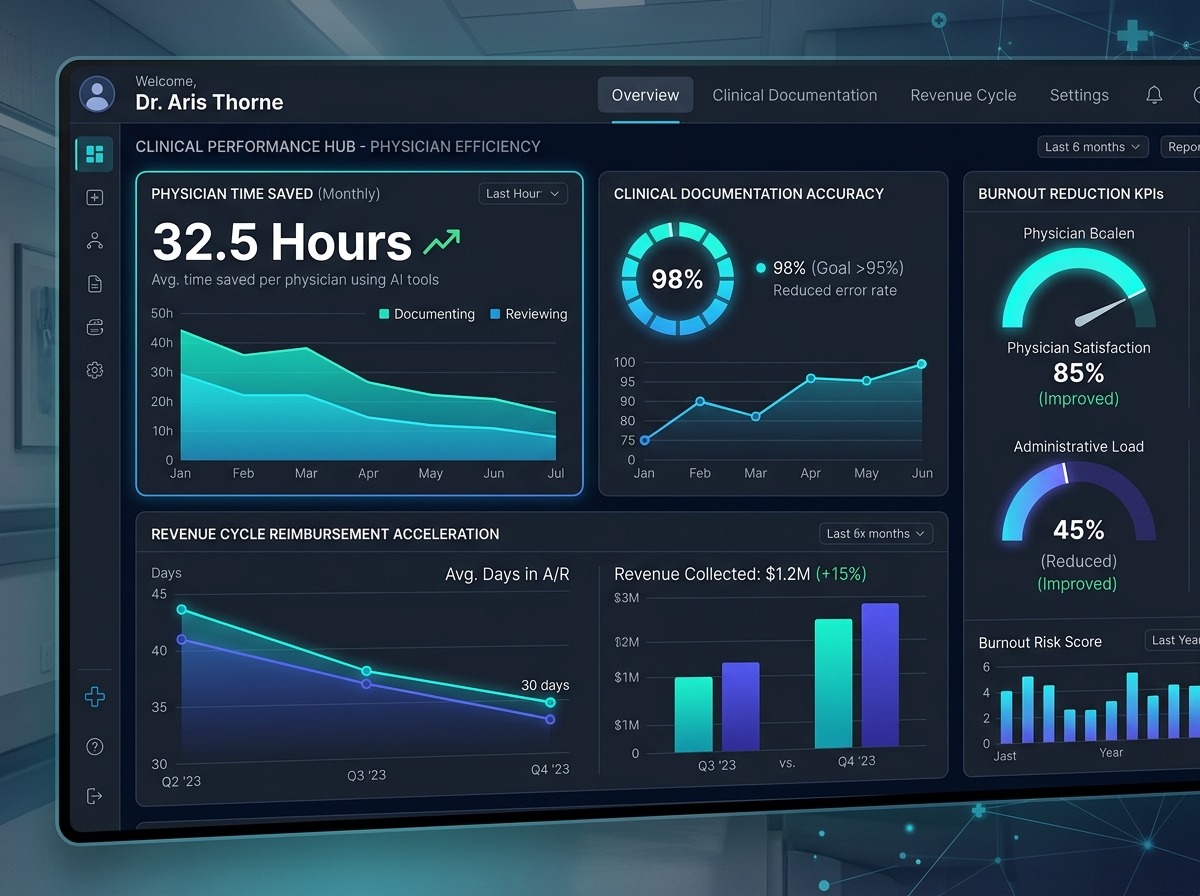
The case for healthcare AI documentation is not just clinical — it is operational and financial. Practices that deploy AI-assisted documentation report measurable improvements across provider wellbeing, revenue cycle performance, and patient satisfaction within the first quarter of implementation.
Eliminates after-hours "pajama time" charting, giving physicians back sustainable work-life balance.
Automated ICD-10/CPT coding reduces claim rejections and accelerates cash flow without extra billing staff.
Fewer transcription errors and missed diagnoses, ensuring clean documentation for compliance.
Notes generated in under 15 seconds allow physicians to care for more patients with zero cognitive overload.
Eye contact and unhurried consultation replace screen-focused typing during patient visits.
Reconciles historical patient charts automatically, building complete records without manual review.
Healthcare data is among the most sensitive information in existence. Every organisation evaluating a HIPAA compliant AI Medical Scribe needs absolute certainty that patient data is protected — at rest, in transit, and at every point of AI processing.
All PHI is encrypted end-to-end (TLS 1.3 in transit, AES-256 at rest). No audio recordings or transcripts stored after note sign-off. BAAs included.
Full compliance across Privacy, Security, and Breach Notification Rules. Independently audited SOC 2 Type II controls and ONC Health IT certified.
Every action taken by the AI is transparent and logged. Physicians can inspect why a note structure or code was suggested. Zero black-box automation.
Medically trained model rigorously validated to perform equitably across diverse patient demographics, accents, languages, and complex clinical scenarios.
The value of AI clinical documentation is only fully realised when it connects seamlessly to the systems your practice already runs. A documentation tool that requires manual copy-paste, tab-switching, or separate login workflows creates friction — and friction kills adoption.
Notes, orders, diagnostic codes, and scheduling flow directly into your existing patient records via certified HL7 FHIR APIs with zero copy-pasting.
"The AI Medical Scribe has given me back two hours every day. I leave the clinic when my patients do, not three hours later."
"Our billing rejections dropped significantly within the first month. The automated coding accuracy is genuinely impressive."
Traditional dictation software requires the physician to stop, dictate, and review a transcript manually. Our AI Medical Scribe uses ambient listening: it works passively in the background during the natural patient conversation, generates a fully structured clinical note automatically, and has it ready for review and sign-off immediately after the encounter. No dictation prompts, no structured scripting, no after-hours work.
Our system achieves an industry-leading accuracy rate of up to 98%, trained on real clinical language by practising physicians. The model understands medical terminology, clinical context, and specialty-specific documentation conventions, and continuously improves its accuracy based on each physician's individual editing patterns over time.
Yes. Our platform is built as a HIPAA compliant AI Medical Scribe from the ground up. All PHI is encrypted end-to-end (TLS 1.3 in transit, AES-256 at rest). No audio or transcript data is retained after the note is finalised. The system holds SOC 2 Type II certification and ONC certification. Business Associate Agreements are provided to all healthcare customers as standard.
Yes. The system includes pre-configured templates and specialty-adapted documentation logic for 30+ medical and surgical specialties including cardiology, psychiatry, orthopaedics, paediatrics, oncology, neurology, and primary care. Each specialty template is configured with the appropriate SOAP structure, clinical terminology, and documentation conventions from day one.
Yes. The system works seamlessly across in-person visits, follow-up appointments, and telemedicine consultations. It captures and structures documentation consistently regardless of the care delivery model, ensuring no clinical encounter is underdocumented because it happened remotely.
Our ambient listening technology accurately recognises and differentiates between multiple speakers during an encounter, including family members, caregivers, specialist consultants, and interpreters. All parties' contributions are captured and correctly attributed in the final clinical documentation.
Most practices reach full deployment within two to four weeks. A dedicated implementation team handles specialty template configuration, EHR integration, and staff onboarding. Ongoing technical support and account management are included throughout the relationship.
Yes. The system uses machine learning algorithms that adapt continuously to each physician's individual documentation style, learning from every edit and approval to reduce review time and improve note accuracy the longer it is used.
Join the thousands of physicians already using AI Medical Scribe technology to reclaim their time, reduce burnout, and deliver better care. No new hardware. No workflow disruption. Just accurate, automatic clinical documentation — from the moment the conversation starts.
WhatsApp us